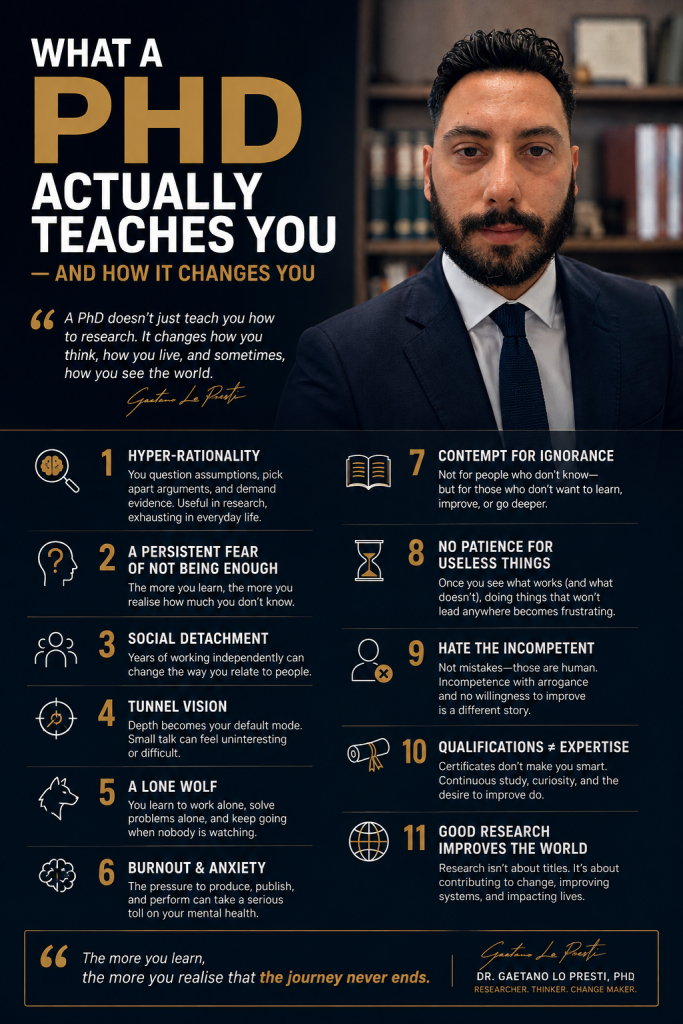
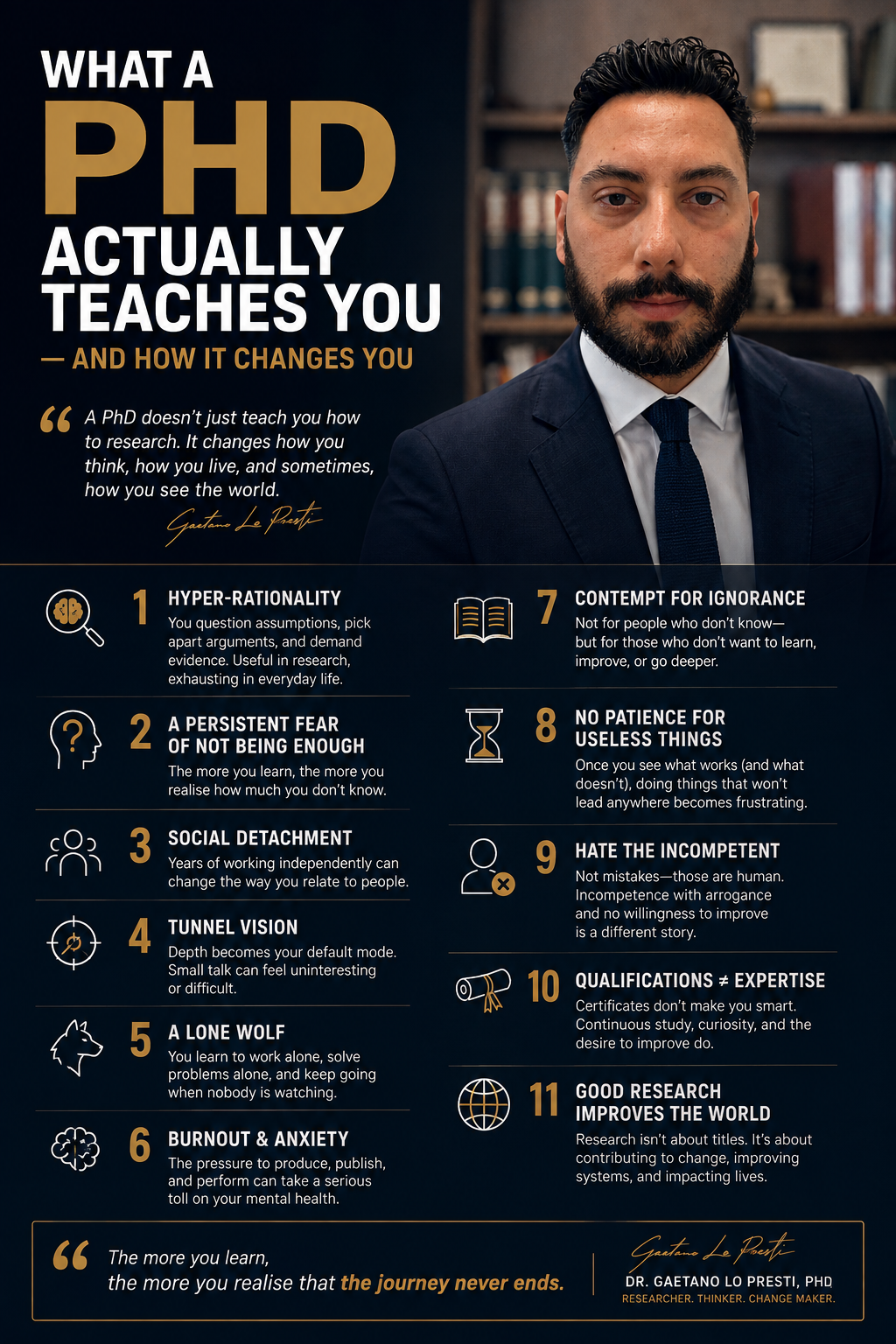
What a PhD Actually Teaches You — And How It Changes You
People often think a PhD teaches you how to become an expert. It does. But that is probably one of the least important things it teaches you. A PhD changes…
People often think a PhD teaches you how to become an expert.
It does.
But that is probably one of the least important things it teaches you.
A PhD changes the way you think. And, at least in my experience, some of those changes are uncomfortable.
Here are 11 things a PhD taught me:
1. You become hyper-rational.
You start questioning assumptions, picking apart arguments and asking, “Where is the evidence?”
Useful in research. Sometimes exhausting in normal conversations. You can come across as overly critical, pedantic or argumentative when you’re simply trying to understand whether something actually makes sense.
2. You develop a persistent fear of not being enough.
There is always another paper to read, another theory to understand, another person who knows more than you. The more you learn, the more you realise how much you don’t know.
3. You become socially detached.
Years of working independently, thinking deeply and spending enormous amounts of time inside your own head can change the way you relate to people.
4. You develop tunnel vision.
When you’re used to spending hours analysing complex problems, everyday small talk can sometimes feel strangely empty or difficult to engage with. Not because other people are boring—but because your brain has become accustomed to depth.
5. You become a lone wolf.
A PhD teaches you that, ultimately, nobody can do the thinking for you. You learn to work alone, solve problems alone and keep going when nobody is watching.
6. You experience burnout and anxiety.
The pressure to produce, publish, perform and constantly prove yourself can be brutal. There are moments when intellectual ambition comes at a very real personal cost.
7. You can develop contempt for ignorance.
Not for people who don’t know. Nobody knows everything.
But for people who don’t want to know.
People who refuse to learn, refuse to question themselves, refuse to go deeper and refuse to improve.
That is something a PhD can make increasingly difficult to tolerate.
8. You lose patience with doing things you already know won’t work.
Once you learn to analyse problems systematically, deliberately doing something that has no realistic chance of producing a result becomes incredibly frustrating.
Why waste time repeating something when the evidence already tells you it won’t work?
9. You develop a very low tolerance for incompetence.
Not imperfection. Not mistakes.
Incompetence combined with arrogance, laziness or an unwillingness to improve.
Making mistakes is human. Refusing to learn from them is a choice.
10. You realise that qualifications don’t make you intelligent.
Passing exams doesn’t make you an expert.
Getting certifications doesn’t make you a genius.
Having letters after your name doesn’t automatically make you intelligent.
What matters is what you do after the qualification.
Do you keep studying?
Do you challenge your own beliefs?
Do you stay up to date?
Do you seek better answers?
Do you admit when you’re wrong?
Real expertise is not a certificate.
It is a commitment to continuous learning.
11. And ultimately, you understand the purpose of research.
Good research isn’t about having a title.
It isn’t about putting “Dr” in front of your name.
It is about discovering something, understanding something better, challenging what we think we know—and, ideally, using that knowledge to contribute to change.
To improve systems.
To improve lives.
To improve the world.
A PhD doesn’t simply teach you how to research.
It changes how you see the world—and, sometimes, how you see yourself in it.
And perhaps the biggest lesson of all is this:
The more you learn, the more you realise that the journey never ends.